
Scan-to-data capture
Printed logbooks and forms scanned with a phone camera, read with OCR and turned into records in the platform.
Capture data where it happens, keep one auditable record, and report against IFRS S1 and S2, GRI and SASB without retyping.
What I build
Printed logbooks and forms scanned with a phone camera, read with OCR and turned into records in the platform.
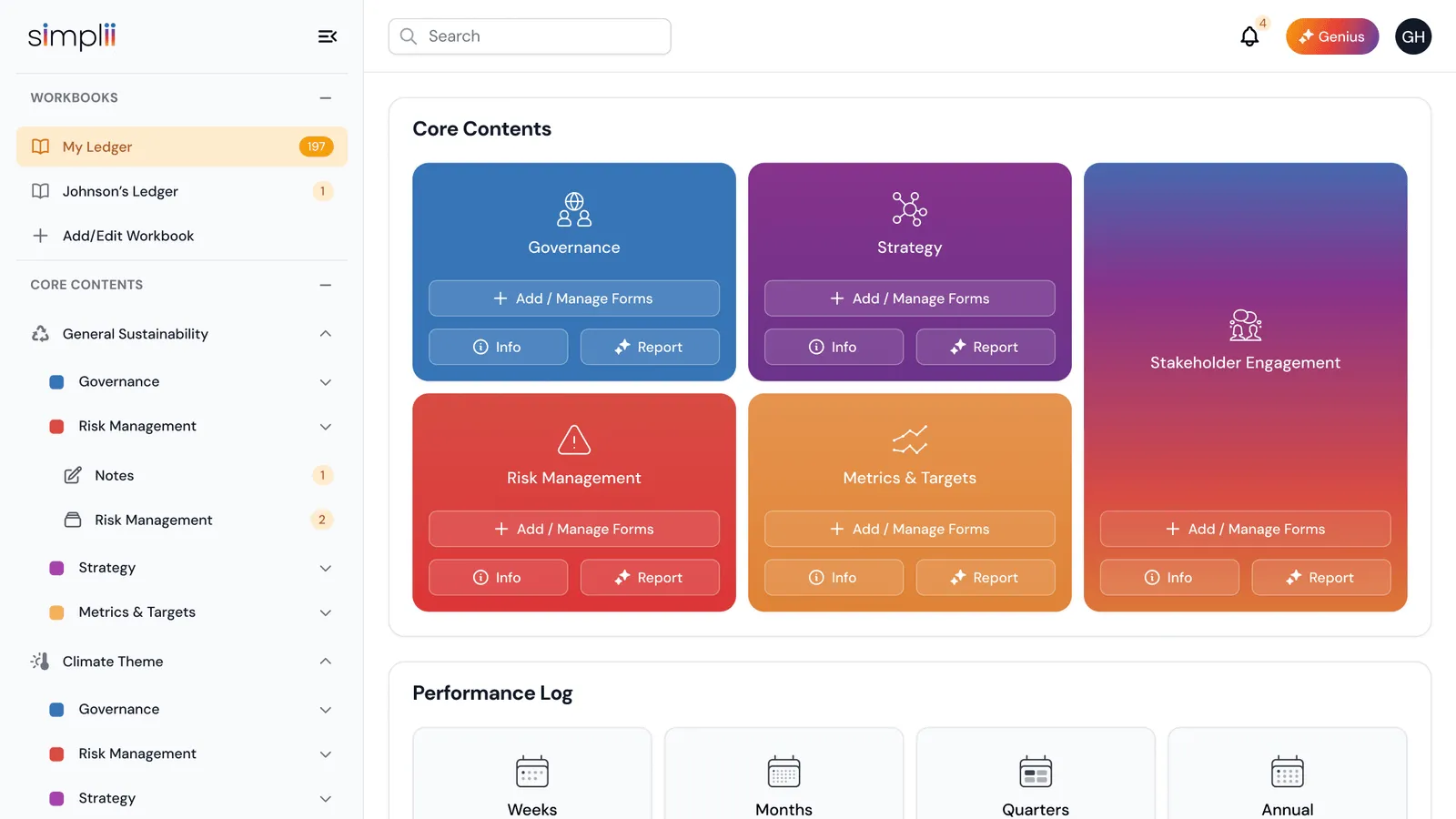
A separate workspace for each company, structured around the frameworks they report against.
One view across every client: progress against each framework, milestones, overdue tasks and what's in progress.
Governance, strategy, risk management, and metrics and targets, with forms, guidance and reports for each.
Every entry linked to its evidence and change history, so a verifier can follow a figure back to its source.
Admins, tenant owners, workbook managers and content managers, each seeing and editing only what they should.
AI, right now
Sustainability reporting is moving from an annual exercise to continuous data: frameworks like IFRS S1 and S2 expect figures that trace back to evidence. Yet much of the source data still starts on paper, in emails and in spreadsheets.
The software that helps is the kind that captures data where it happens and keeps one auditable record from the first entry to the annual report. That’s what I worked on as founding engineer at 7Centre: a scan-to-data pipeline and the Simplii platform for companies and consultants.
OCR and AI turn scanned pages, utility bills and invoices into structured activity data, checked by a person.
An assistant that answers "where does this go under IFRS S2?" from the published standard and your own documents, with the citation.
Activity data checked as it arrives, so a misread meter or a wrong unit is caught in the week it happened.
Draft narrative sections from your structured data, for your experts to review and own.
Proof
MVP and SaaS development
As founding engineer at 7Centre, I built a Flutter app that scans their printed Sustainability Ledger and worked on Simplii, their multi-tenant ESG platform.
Call
A 30-minute call about what you need, who it is for, and what success looks like.
Scope
A written scope: features, architecture, timeline, price range and risks.
Build
Working increments you can click through, not a big reveal at the end.
Ship
Live on your domain and hosting, with a handover so you know how it runs.
More in how I work, or see mvp and saas development.
Questions
Your sustainability experts own the methodology; I build the software around it. On Simplii, the frameworks and content came from 7Centre's own practitioners.
Yes. That's what the Simplii scan-to-data pipeline was built for: people record where it's easiest, and the data still ends up structured in the platform.
Both. Companies get a workspace for their own reporting; consultancies get a cross-client dashboard to run many clients at once.
A first version is a fixed-price MVP, from $3,000, scoped after a 30-minute call. Larger platforms are planned in phases, each with its own written scope.
A 30-minute call is enough to tell whether it fits, what the first version should include, and how long it takes.
 Prayag Dalal · Top Rated on Upwork, 34 jobs completed