
Pipeline and quoting
Opportunities on a Kanban board with stages and probabilities, flowing straight into quotes and PDFs.
From first lead to final invoice in one system your whole team works in, instead of a CRM, a project tool and spreadsheets that never agree.
What I build
Opportunities on a Kanban board with stages and probabilities, flowing straight into quotes and PDFs.
Running projects with tickets, owners, deadlines, timesheets and budgets that update as work happens.
Requests routed to the right role for approval, with in-app and email notifications so nothing waits in an inbox.
Milestones from the quote, invoices tracked to payment, and overdue accounts flagged automatically.
Revenue and margin forecasts tied to real pipeline data, with scenarios leadership can compare.
Existing clients, projects and invoices brought in from spreadsheets, checked before anything is saved.
AI, right now
Agencies, consultancies and IT services firms tend to run the same lifecycle (lead, quote, project, invoice, payment) across tools that were never designed to work together. Sales can’t see delivery, delivery can’t see margins, and finance chases payments from a spreadsheet.
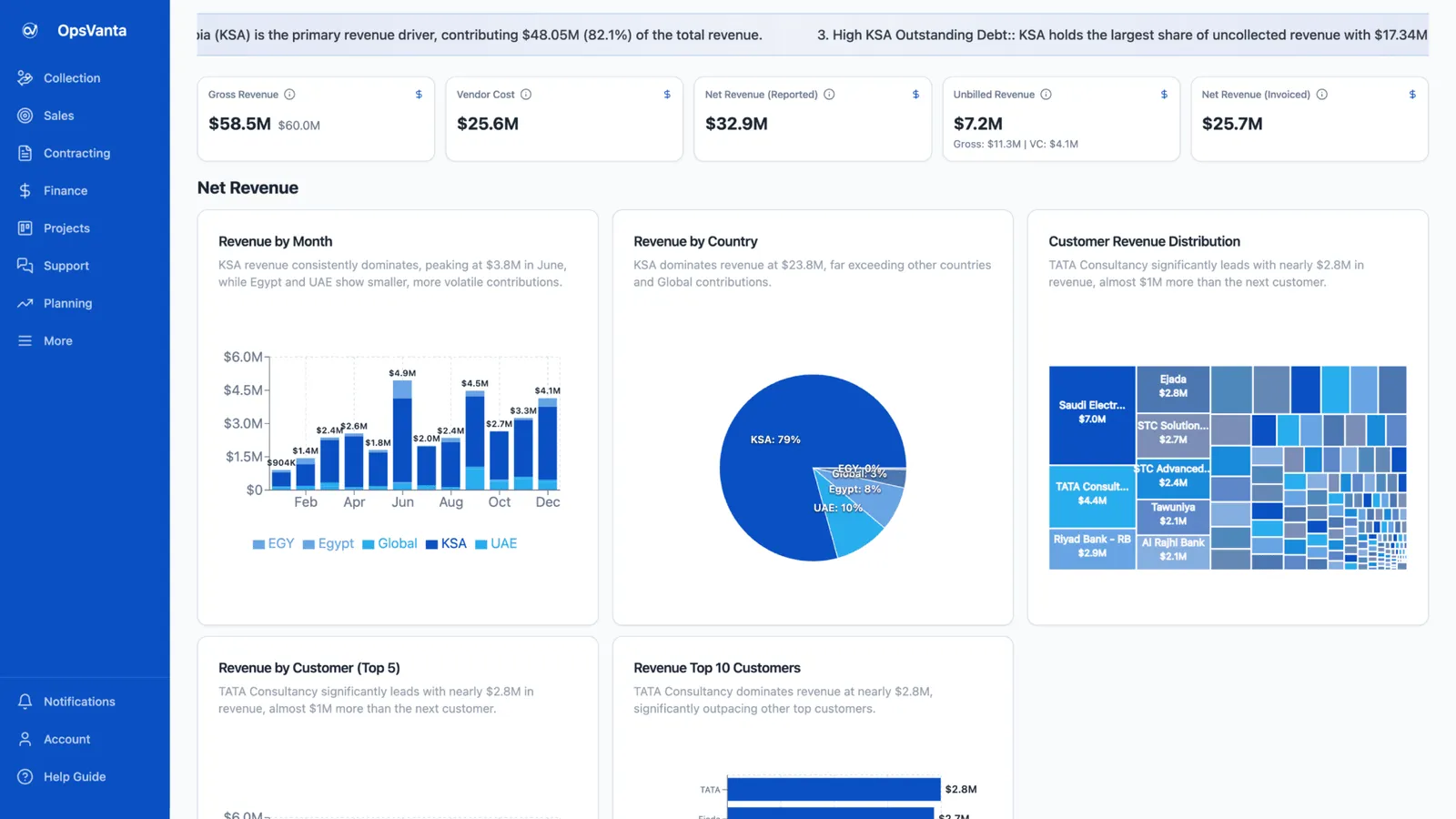
One system on one data model changes that: every figure traces from the first opportunity to the bank. That’s what OpsVanta does for IST Networks, built solo and now used across the company.
AI turns live pipeline, delivery and finance data into a short summary of what changed and what needs attention.
Collection suggestions tailored to each account's history, for your team to act on.
Line-item descriptions and proposal text drafted from the opportunity, then edited by a person.
Company details filled in and checked automatically when a new client is added.
Proof
MVP and SaaS development
An internal ERP built solo with Lovable and Claude Code on Lovable Cloud, running sales, projects, tickets, collections, finance and AI insights in one place.
Call
A 30-minute call about what you need, who it is for, and what success looks like.
Scope
A written scope: features, architecture, timeline, price range and risks.
Build
Working increments you can click through, not a big reveal at the end.
Ship
Live on your domain and hosting, with a handover so you know how it runs.
More in how I work, or see internal tools.
Questions
If one fits, use it. Firms come to custom tools when their process doesn't match the software, when they're paying for several tools that don't share data, or when every report still ends in Excel. A custom system follows how your firm actually works.
Yes. The system is built and rolled out in modules, and existing data is imported from your spreadsheets, so teams move over one area at a time.
The builder doesn't decide that; the data model, access rules and review do. OpsVanta runs on PostgreSQL with row-level security on all 120 tables, and almost everyone at IST Networks works in it.
A first version is a fixed-price project agreed after a 30-minute call. Ongoing development usually runs on a monthly retainer, $1,200 for 10 hours a week or $2,400 for 20.
A 30-minute call is enough to tell whether it fits, what the first version should include, and how long it takes.
 Prayag Dalal · Top Rated on Upwork, 34 jobs completed